
DNA OF LIGHT
Translating the language of life into architecture
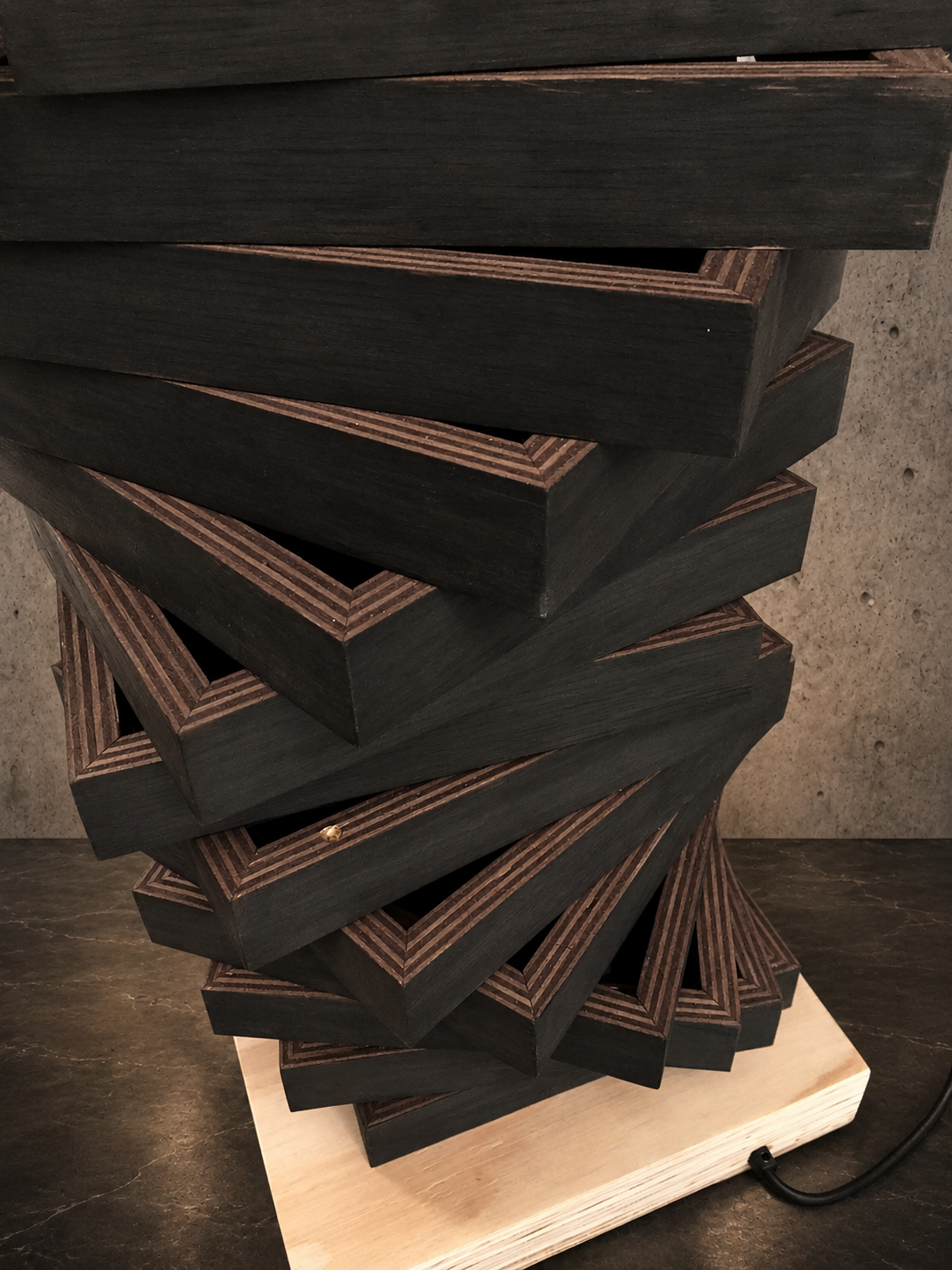
DNA of Light — a sculptural light installation by MXN DESIGN, formed from 32 rotating square frames around a central warm light source, inspired by the structure of the DNA double helix.
DNA of Light is an exploration of the point where architecture, light, and life meet.
It began with a question that has stayed with me for years: could something as fundamental as the language of life be translated into architecture?
The starting point was the familiar double helix of human DNA, two opposing spirals carrying the information from which we’re built.
I didn’t want to copy that form. I wanted to find an architectural language for it.
The number 256 became part of that language. I chose it as a direct reference to human genetics, inspired by published estimates for the number of protein-coding genes on chromosome 21.
I translated that number into the structure itself: thirty-two square frames, each with eight defining corner points, two hundred and fifty-six points in total, forming the numerical code of its architectural DNA.
From the centre, the frames begin to rotate.
The lower half turns in one direction, the upper half turns in the other.
Layer by layer, a simple square begins to transform. The geometry twists, overlaps and opens until rigid architectural form starts to suggest something organic, an interpretation of the opposing movement of the double helix.
And through the centre runs light.
The light is not simply there to illuminate the object. It represents life.
Light is one of the most fundamental conditions of the world we inhabit. It gives energy, enables growth, defines space, and allows us to perceive everything around us. Without the light of the sun, life on Earth as we know it could not exist.
So within DNA of Light, the light becomes the living element held inside the geometry.
As the frames turn around it, the light is constantly revealed and concealed.
It appears through one opening, disappears behind another, and changes depending on where the object is viewed from.
The structure remains fixed, the experience of it never does.
For me, that’s where it moves beyond being a lamp or even just a sculpture. It sits somewhere between architecture, object, and idea.
Architecture is normally created around the human being, our scale, our movement, our needs, the spaces we inhabit.
With DNA of Light, I wanted to go further.
Instead of designing only around the human body, I wanted to make a connection to something far deeper: the information from which the human body itself is built.
The geometry becomes the structure, the helix becomes the movement, the number becomes the code, and the light becomes life.
DNA of Light is architecture reduced to geometry, and life reduced to light.
From prototype to monument
The piece shown here is a working prototype, approximately 1.5 metres high.
But my DNA of Light was never conceived to remain at this scale.
The intention is to realise it as a freestanding structure approximately seven metres high, placed in the landscape as an object in its own right — visible by day as a sculptural form, and after dark as a vertical beacon of light.
At that scale, the relationship between architecture, geometry and the human body changes completely. What can now be walked around as an object would become something closer to a landmark.
A structure standing alone in a field.
Silent by day.
Glowing after dark like a beacon.